
Tips – Submitting Your Resume
- Do not lie on your resume – it is a criminal offence.
- Ensure valid dates of employment are reflected for each position.
- List 5–7 key duties performed at each company.
- State the position you held at the company.
- State reasons for leaving for each company.
- Most recent company must always reflect first.
Before sending your CV today, double-check you have read through and meet the vacancy requirements!
Tips – The Phone Call
Once a hiring manager receives a resume which makes their initial short-list, they will respond either via email or phone call. Today we are concentrating on tips for “the first response call.”
- Number one rule – sound alive when you answer the phone! Treat every caller as a future employer. Answering your phone with a lazy “Hi” or abrupt “Yes?” is a no!
- Find a place with the least amount of background noise e.g. no blaring music, crying or screaming children, loud-mouthed friends/partners, machinery, etc.
- Have a pen and paper handy at all times. Do not say you are ready and still be trying to find something to write on. If you miss the important details it could cost you.
- There is no shame in not being available. If the call comes at an inconvenient moment, be well-mannered. State “I’m sorry, but I wasn’t expecting this call, and won’t be able to give it my full attention. Can we reschedule?” This shows respect, and asking to reschedule confirms interest.
- Ensure you have all the details before ending the call: name of contact, position applied for, and contact details to follow up.
Tips for Submitting Your Resume
- Make sure you have read through the entire vacancy advert, including essential requirements, before sending your resume. (If you do not meet the requirements, the company is under no obligation to respond – you are probably wasting your time and money.) Note: with the POPI Act, companies when audited will have to prove why they have retained your resume, should they not have a suitable current vacancy or future workable specification.
- Make sure you have the correct contact name and response details.
- Ad response call: ensure you know who the contact person is and the position you are applying for. Don’t call and say you are applying for “the vacancy” without knowing what the vacancy is – the client may be dealing with more than one.
- Emailing your CV: always state the position applying for and your name on the subject line (if your email address doesn’t include your name, it is harder for the client to find your details when a response is required); double-check that your CV is attached before sending; introduce yourself on the email – blank emails can easily be viewed as spam and thus be deleted unopened. Add your contact details in the signature.
Before You Send That Job Application Today – Please Check the Following
- Your contact details are up-to-date and correct on the CV.
- There are no spelling or grammar errors – check and double check.
- Area, date of birth, nationality, languages, ethnicity, driver’s license – all to be visible on your CV under personal details.
- Check that your education and qualifications are on the CV.
- Employment history must start from the most recent employer.
- A minimum of 5–7 key duties performed at each employer.
- Valid reasons for leaving each employer.
- A bumper introduction paragraph or letter.
- Ensure you mark on your email application the post you are applying for, and an introduction even if just a couple of sentences.
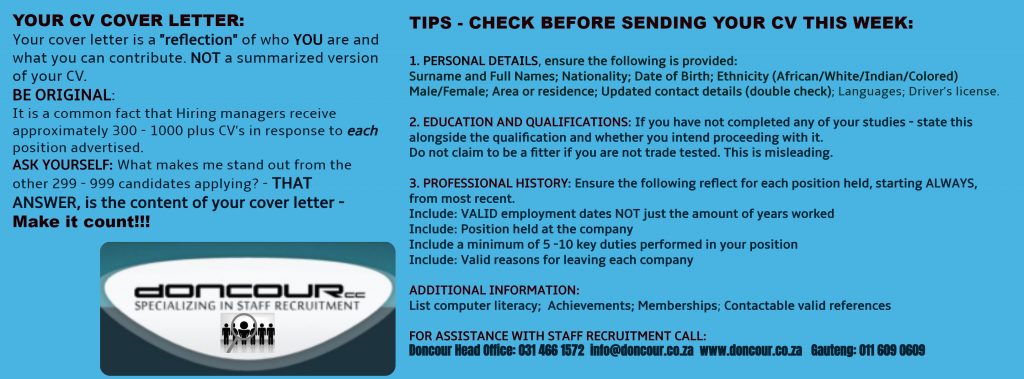
Your CV Cover Letter
Your cover letter is a “reflection” of who you are and what you can contribute, not a summarised version of your CV. Be original: it is a common fact that hiring managers receive approximately 300–1000 plus CVs in response to each position advertised. Ask yourself: what makes me stand out from the other 299–999 candidates applying? That answer is the content of your cover letter – make it count!
Tips – check before sending your CV this week:
- Personal details, ensure the following is provided: surname and full names; nationality; date of birth; ethnicity (African/White/Indian/Coloured); male/female; area or residence; updated contact details (double check); languages; driver’s license.
- Education and qualifications: if you have not completed any of your studies, state this alongside the qualification and whether you intend proceeding with it. Do not claim to be a fitter if you are not trade tested – this is misleading.
- Professional history: ensure the following reflect for each position held, starting always from most recent. Include valid employment dates, not just the amount of years worked; position held at the company; a minimum of 5–10 key duties performed in your position; valid reasons for leaving each company.
Additional information: list computer literacy, achievements, memberships and contactable, valid references.
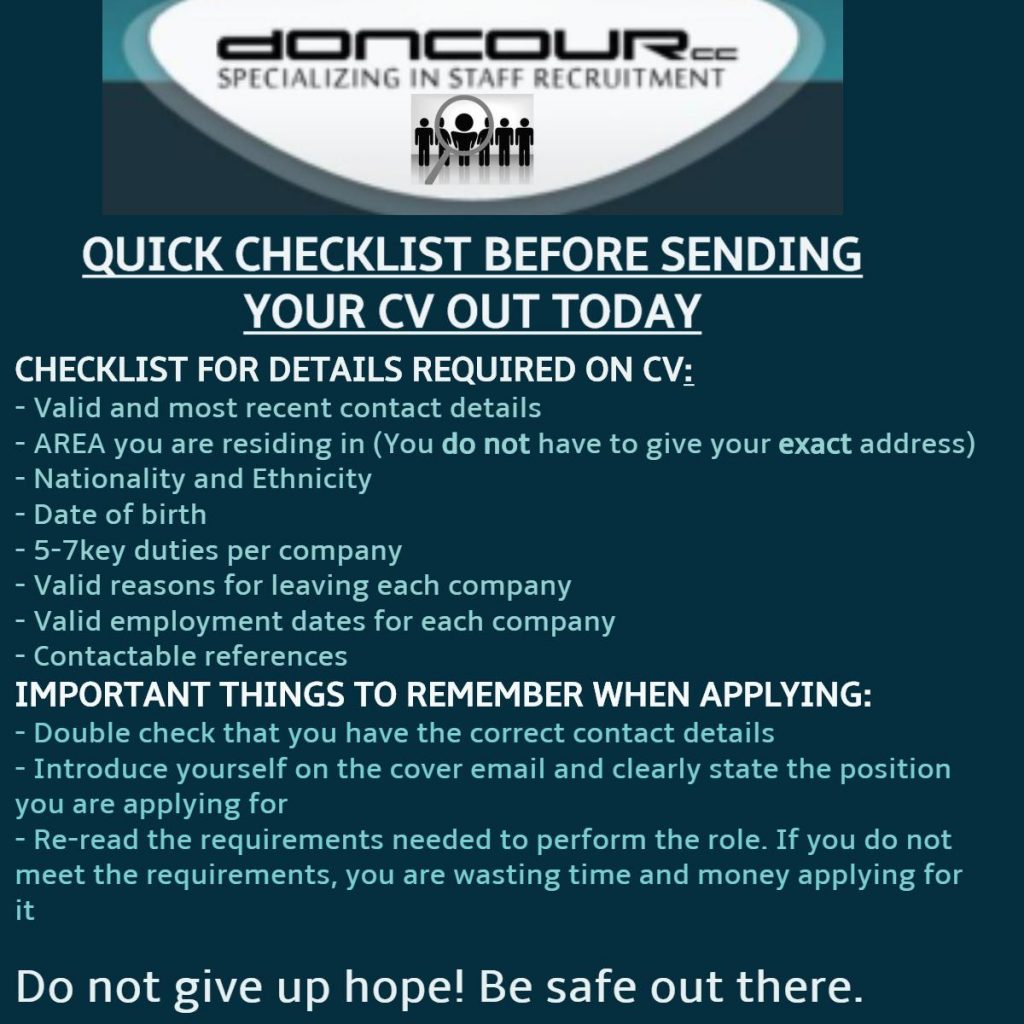
Quick Checklist Before Sending Your CV Out Today
Checklist for details required on CV:
- Valid and most recent contact details.
- Area you are residing in (you do not have to give your exact address).
- Nationality and ethnicity.
- Date of birth.
- 5–7 key duties per company.
- Valid reasons for leaving each company.
- Valid employment dates for each company.
- Contactable references.
Important things to remember when applying:
- Double check that you have the correct contact details.
- Introduce yourself on the cover email and clearly state the position you are applying for.
- Re-read the requirements needed to perform the role. If you do not meet the requirements, you are wasting time and money applying for it.
Do not give up hope! Be safe out there.
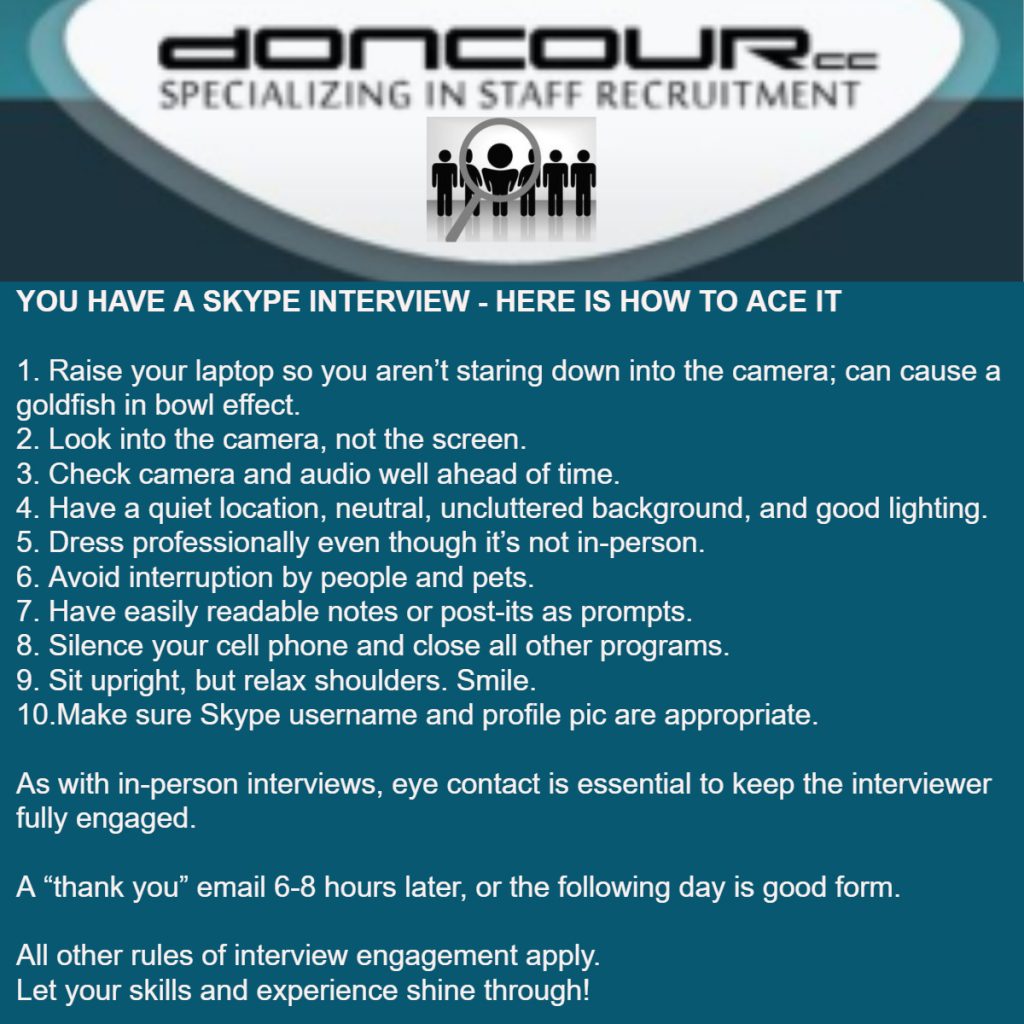
You Have a Skype Interview – Here Is How to Ace It
- Raise your laptop so you aren’t staring down into the camera; it can cause a goldfish-in-a-bowl effect.
- Look into the camera, not the screen.
- Check camera and audio well ahead of time.
- Have a quiet location, a neutral, uncluttered background, and good lighting.
- Dress professionally even though it’s not in-person.
- Avoid interruption by people and pets.
- Have easily readable notes or post-its as prompts.
- Silence your cell phone and close all other programs.
- Sit upright, but relax your shoulders. Smile.
- Make sure your Skype username and profile picture are appropriate.
As with in-person interviews, eye contact is essential to keep the interviewer fully engaged. A “thank you” email 6–8 hours later, or the following day, is good form. All other rules of interview engagement apply – let your skills and experience shine through!
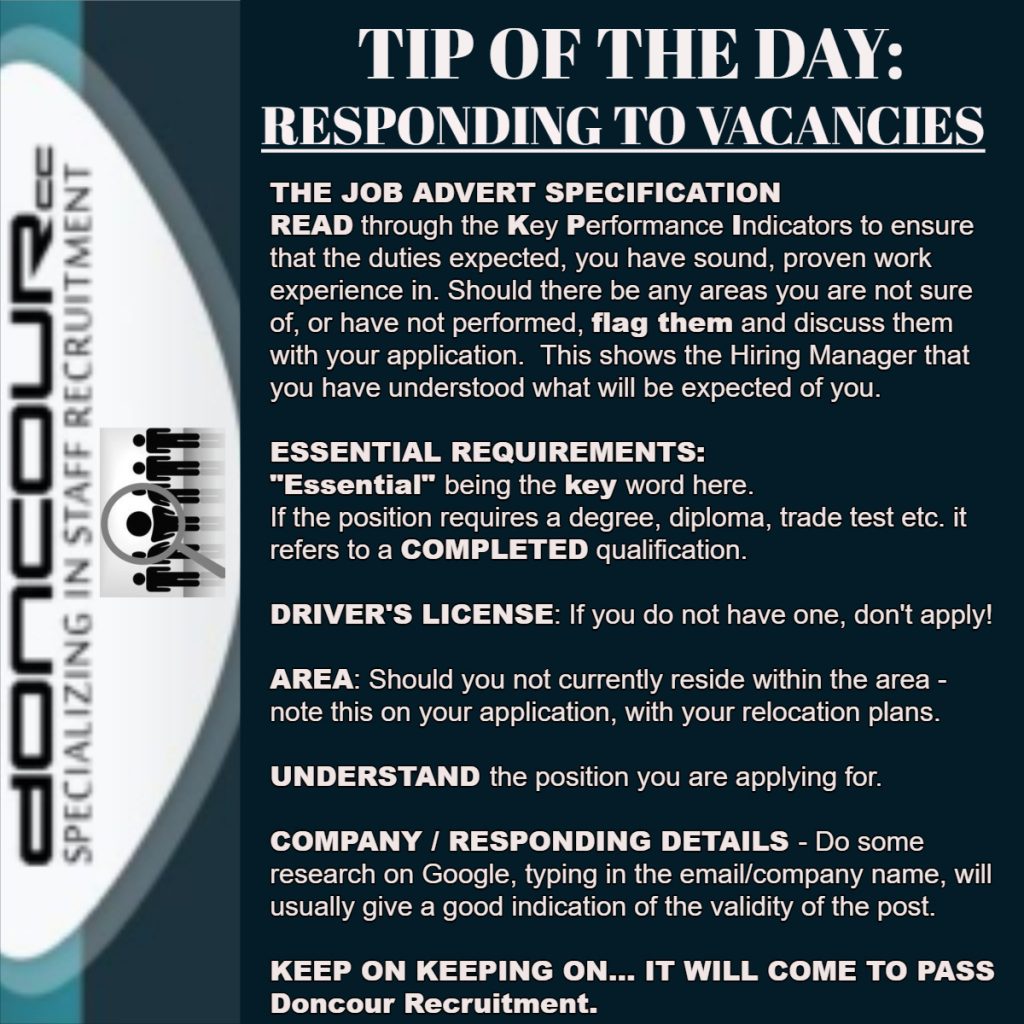
Tip of the Day: Responding to Vacancies
The job advert specification: read through the Key Performance Indicators to ensure that the duties expected are ones you have sound, proven work experience in. Should there be any areas you are not sure of, or have not performed, flag them and discuss them with your application. This shows the hiring manager that you have understood what will be expected of you.
Essential requirements: “essential” being the key word here. If the position requires a degree, diploma, trade test etc. it refers to a completed qualification.
Driver’s license: if you do not have one, don’t apply!
Area: should you not currently reside within the area, note this on your application, with your relocation plans.
Understand the position you are applying for.
Company / responding details: do some research on Google, typing in the email/company name, which will usually give a good indication of the validity of the post.
Keep on keeping on… it will come to pass.
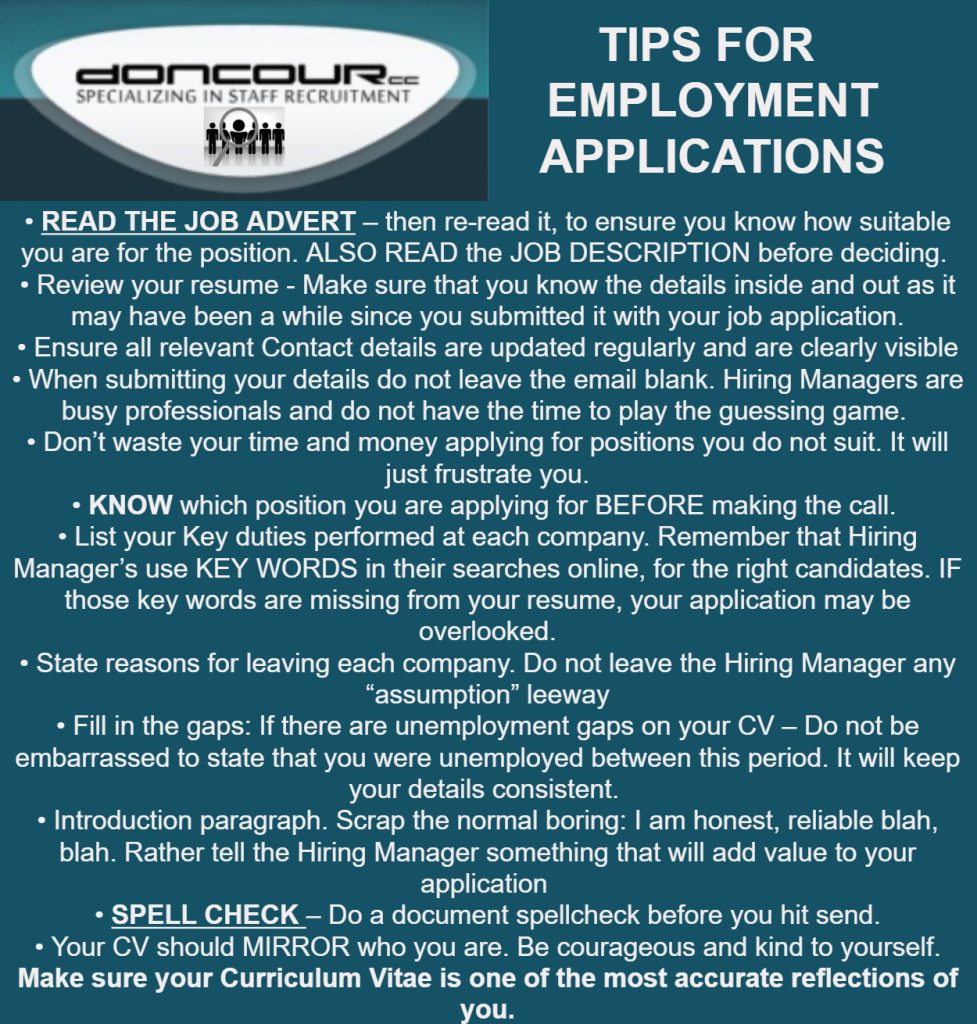
Tips for Employment Applications
- Read the job advert – then re-read it, to ensure you know how suitable you are for the position. Also read the job description before deciding.
- Review your resume – make sure that you know the details inside and out, as it may have been a while since you submitted it with your job application.
- Ensure all relevant contact details are updated regularly and are clearly visible.
- When submitting your details do not leave the email blank. Hiring managers are busy professionals and do not have the time to play the guessing game.
- Don’t waste your time and money applying for positions you do not suit. It will just frustrate you.
- Know which position you are applying for before making the call.
- List your key duties performed at each company. Remember that hiring managers use key words in their searches online for the right candidates – if those key words are missing from your resume, your application may be overlooked.
- State reasons for leaving each company. Do not leave the hiring manager any “assumption” leeway.
- Fill in the gaps: if there are unemployment gaps on your CV, do not be embarrassed to state that you were unemployed between this period. It will keep your details consistent.
- Introduction paragraph: scrap the normal boring “I am honest, reliable” blah, blah. Rather tell the hiring manager something that will add value to your application.
- Spell check – do a document spellcheck before you hit send.
- Your CV should mirror who you are. Be courageous and kind to yourself.
Make sure your curriculum vitae is one of the most accurate reflections of you.